Prepared for West Norfolk Befriending by Adrian Taylor, 2026-10-05. If you work there and would rather this page came down, say so and it comes down.
West Norfolk Befriending: what the records show, and what we could do together
Adrian Taylor runs Charity in a Box, after twenty years working in charities and public services. About Adrian.
1. What you say, and where we read it
We read your website (West Norfolk Befriending – Providing a listening ear (charity no. 1111735)) and your public channels.
Your channels: x (closed to readers, not read); facebook (closed to readers, not read).
2. Norfolk’s charities, from outside
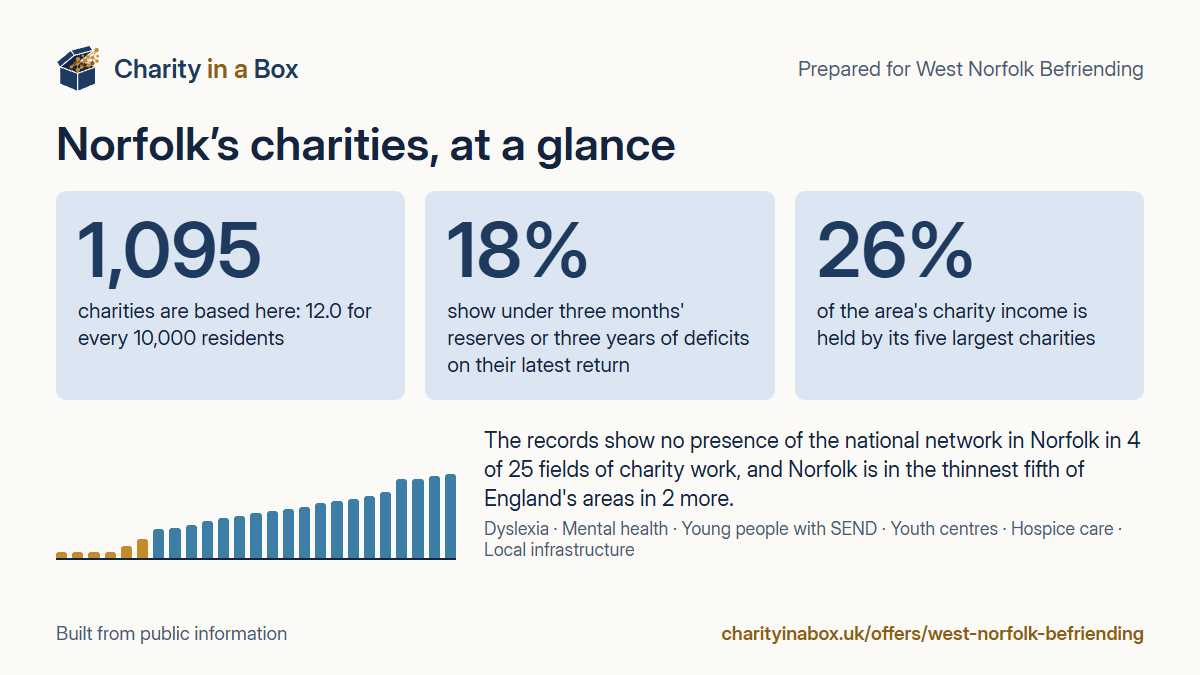
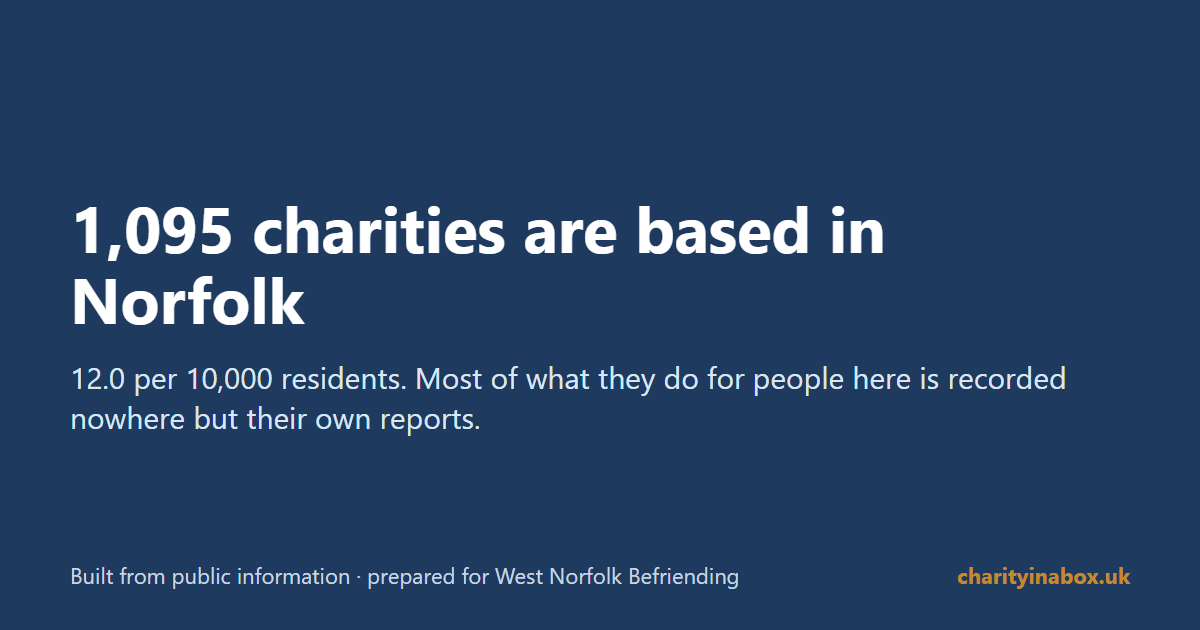
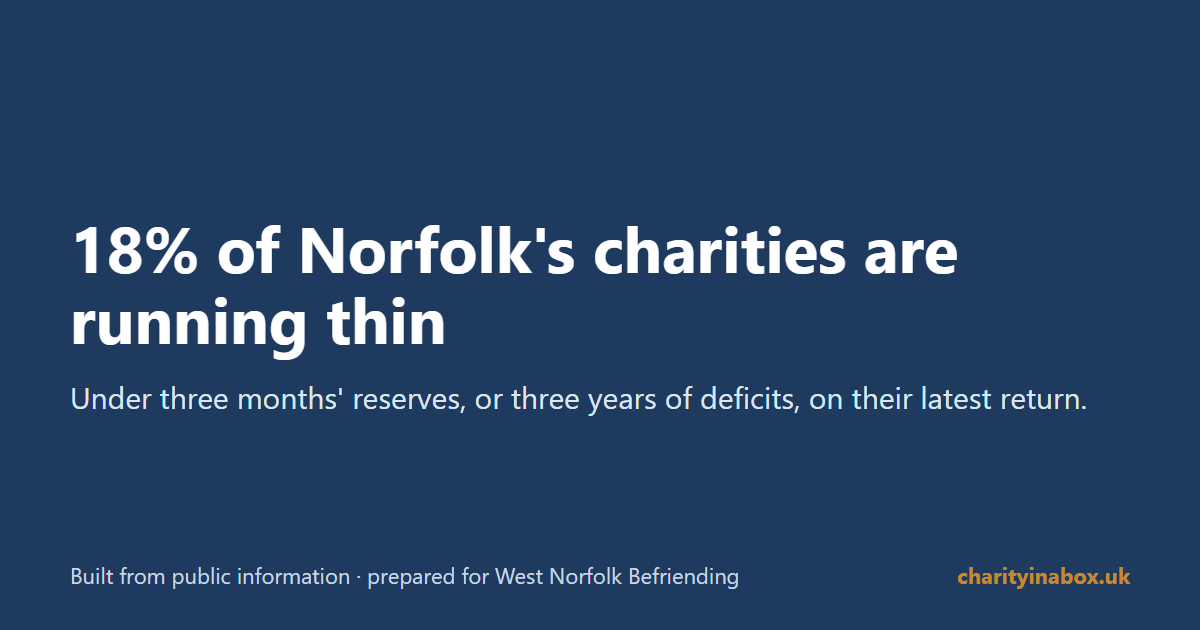
1,095 charities are based in Norfolk, 12.0 for every 10,000 residents, where 20% of residents are on low incomes. 18% show under three months’ reserves or three years of deficits on their latest return; 10% take half or more of their income from government. The five largest hold 26% of the area’s charity income.
Befriending in Norfolk
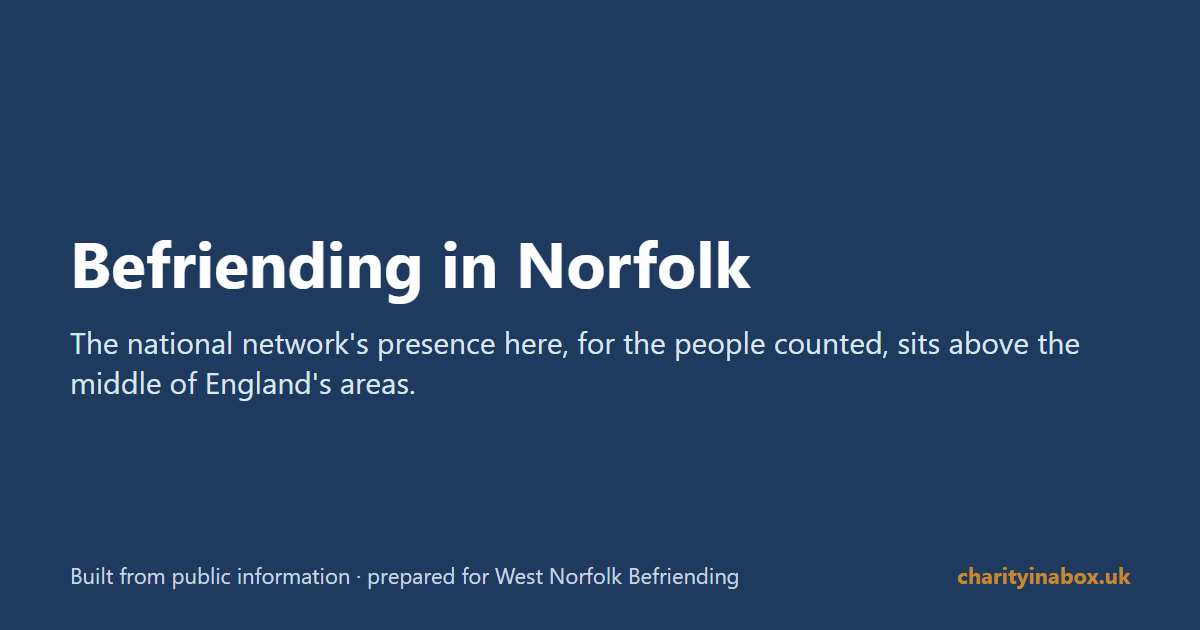
In Norfolk, the national network for your field (befriending) sits above the middle of England's areas for the number of people counted there (gold in the chart below where a field has none recorded here or is in the thinnest fifth). Across England, 5,929 charities outside the field say in their own reports that they serve the same people, against 139 in it.
The 25 fields, against England
For each field of charity work we have mapped, where Norfolk stands among England’s 152 areas for the presence of the national network per person in need. Gold bars are the fields where no presence is recorded here (4 of 25) and those in the thinnest fifth of areas (2).
Dyslexia
Mental health
Young people with SEND
Youth centres
Hospice care
Local infrastructure
Food aid
Rural communities
Learning disability
Drug and alcohol services
Community foundations
Veterans
Unpaid carers
Young people
Families with young children
Legal help
Cadets
Disability services
Older people living alone
Kidney patients
Befriending
Homelessness
Community transport
Almshouses
Riding for the disabled
Norfolk: the bar is where the area stands among England's 152 areasnone recorded here, or in the thinnest fifthEngland's median area
Point at a bar for its figures.
Who does the work here, by register purpose
Norfolk1,095 charities
Education/training539
General charitable purposes333
Religious activities224
Amateur sport192
Arts, culture, heritage, sci…191
Health174
Disability163
Recreation158
Poverty relief156
Environment156
Economic/community developme…145
Other purposes109
A charity records up to three purposes, so the circles overlap. Point at one for its count.
Researchers who studied how charities support people with dementia across the United Kingdom concluded:
“National and local data sources could help charities and commissioners begin to identify inequalities of provision.”
Mayrhofer, Goodman, Lafortune, Smeeton, Littlechild, Shora and Bunn, Voluntary Sector Review, first published 2021. Read the paper.
This page is that view for Norfolk.
3. Sample campaign
Three posts in your voice from the figures above, each with its picture, ready to use. Every figure is from public information and no charity is named.
Bluesky / X: Befriending in Norfolk: the national network's presence, for the people counted here, sits above the middle of England's areas. Who else does the work: https://www.charityinabox.uk/offers/west-norfolk-befriending.html
LinkedIn: Befriending in Norfolk: the national network's presence, for the people counted here, sits above the middle of England's areas. Who else does the work: https://www.charityinabox.uk/offers/west-norfolk-befriending.html
Built from public information; no charity is named.
Bluesky / X: 1,095 charities are based in Norfolk: 12.0 for every 10,000 residents. We've read what they say they do. https://www.charityinabox.uk/offers/west-norfolk-befriending.html
LinkedIn: 1,095 charities are based in Norfolk: 12.0 for every 10,000 residents. We've read what they say they do. https://www.charityinabox.uk/offers/west-norfolk-befriending.html
Built from public information; no charity is named.
Bluesky / X: 18% of Norfolk's charities show under three months' reserves or three years of deficits on their latest return. Which fields, and who else is at work: https://www.charityinabox.uk/offers/west-norfolk-befriending.html
LinkedIn: 18% of Norfolk's charities show under three months' reserves or three years of deficits on their latest return. Which fields, and who else is at work: https://www.charityinabox.uk/offers/west-norfolk-befriending.html
Built from public information; no charity is named.
Your area's charities from outside, with your own field first: how thin the known network is here for the people you work with, who else does the work, how exposed the area's charities are, what the money looks like. A page like this one, in full, refreshed each quarter.
£600 once, or £1,200 a year with four refreshes
A campaign from the findings
Three to five posts a month in your voice, each with its picture, from your area's own figures.
£250 a month
The first month: a twenty-minute call, your page in full within a week, and the first campaign posts the week after. Prices are set by income band from the public register and are the same for everyone in the band.
5. How to say yes
Reply to the email with a day that suits, call or text Adrian on the number in the email (it is on the Contact page too), or write to adrian@charityinabox.uk.
What this can and cannot say. These are counts over groups of charities and places from their own returns and reports and from national statistics. They do not rank any charity, name any, or say why. A thin field is one where the known network is thin for the people counted here, not one where nobody is helped.
Built from public information: the Charity Commission for England and Wales register and the annual reports charities file with it (OGL v3.0); Census 2021 (ONS); the English Indices of Deprivation 2025 (MHCLG); the Claimant Count (ONS). Privacy.